The government physicist who risked everything in 1989 to reveal the existence of Area 51, the clandestine mountain hangars of S-4, and the reverse-engineering of extraterrestrial gravity propulsion systems powered by Element 115.
Before Bob Lazar stepped forward on KLAS-TV with investigative journalist George Knapp in May 1989, "Area 51" did not exist in the public lexicon. Lazar provided an astonishing, hyper-detailed technical account of nine disc-shaped craft housed inside camouflaged hangars at Papoose Lake, the physics of gravity wave amplification, and the sub-atomic mechanics of superheavy elements—decades before mainstream physics verified their existence.
VISUAL DOSSIER
S-4 RECONNAISSANCE
"The craft doesn't fly by aerodynamics. It doesn't push against air. It creates a gravitational distortion in front of itself, and falls into that distortion."
From building 200 MPH jet cars in New Mexico to a personal introduction by Dr. Edward Teller—the unique background that led an unorthodox experimental physicist into the military's most secret facility.
LOS ALAMOS 1982
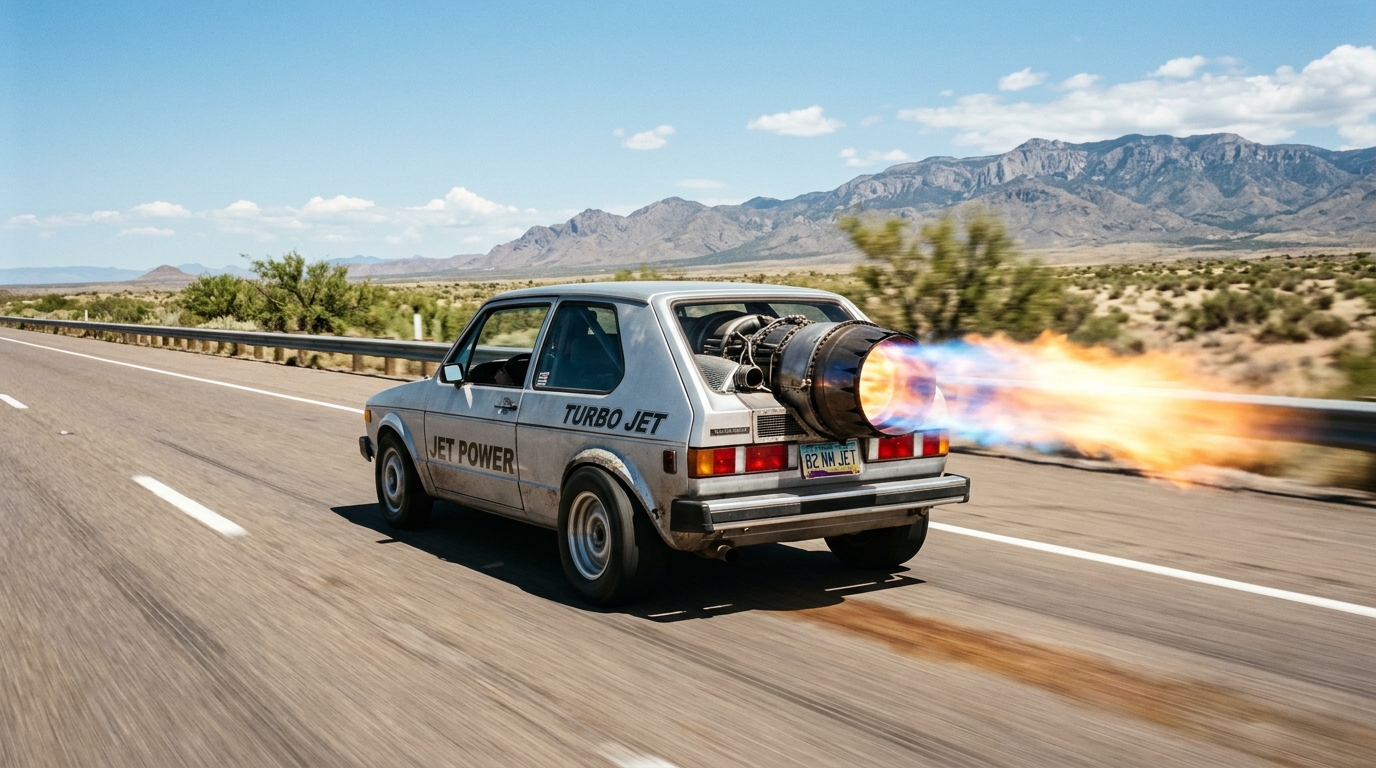
In 1982, while working in New Mexico, Lazar modified a Honda hatchback by retrofitting a custom jet engine powered by kerosene and liquid propane. He drove the jet car on New Mexico highways at speeds surpassing 200 MPH, capturing nationwide attention.
Prior to a scientific lecture at Los Alamos National Laboratory, Lazar arrived early and saw legendary physicist Dr. Edward Teller (father of the hydrogen bomb) reading the front page of the Los Alamos Monitor featuring Lazar's jet car. Bob introduced himself, sparking a relationship that would alter his destiny.
In 1988, Lazar contacted Dr. Teller seeking new research opportunities. Teller referred him to defense contractor EG&G in Las Vegas. After intense polygraphs and background investigations, Lazar was recruited into a Special Access Program (SAP) overseen by the Department of Naval Intelligence.
Born in Coral Gables, Florida in 1959, Robert Scott Lazar was an autodidact with an insatiable appetite for practical physics, propulsion, chemistry, and high-energy systems. Rather than confining his interest to blackboard equations, Lazar built functional hardware—mixing rocket fuels, experimenting with linear particle accelerators, and machining custom alloys in his garage laboratories.
In the early 1980s, Lazar moved to Los Alamos, New Mexico, working as a contractor-physicist associated with the Los Alamos Meson Physics Facility (LAMPF). His hands-on mechanical prowess and fearless experimental style were recognized by both peers and senior scientists. When he engineered his famous jet-powered Honda, local media documented his accomplishments as a Los Alamos physicist pushing experimental transport to the edge.
It was this combination of theoretical comprehension and rare hands-on diagnostic engineering that made Lazar uniquely attractive to EG&G and the Department of Naval Intelligence. They did not need purely theoretical academics; they needed someone capable of disassembling, probing, and comprehending an operational, non-human technology that defied terrestrial thermodynamic paradigms.
Between December 1988 and April 1989, Bob Lazar worked inside Sector Four (S-4)—a subterranean facility built inside the base of Papoose Mountain, completely separate from main Area 51.
S-4 is situated approximately 15 miles south of the Groom Lake main base on the edge of Papoose Dry Lake bed. Unlike standard above-ground military facilities, S-4 was carved directly into the mountain range.
The entrance consisted of nine hangar doors sloped at an identical 30-degree incline to the natural mountainside, textured and coated with sand-colored epoxy and desert camouflage to be completely invisible from overhead satellite and aerial reconnaissance. Commuters arrived via the unmarked "Janet" Boeing 737 from Las Vegas to Groom Lake, followed by a window-blackened bus transit directly to S-4.
On his first walk through the connecting hangar bay, Lazar witnessed nine distinct flying craft housed side-by-side, each separated by sliding partitions.
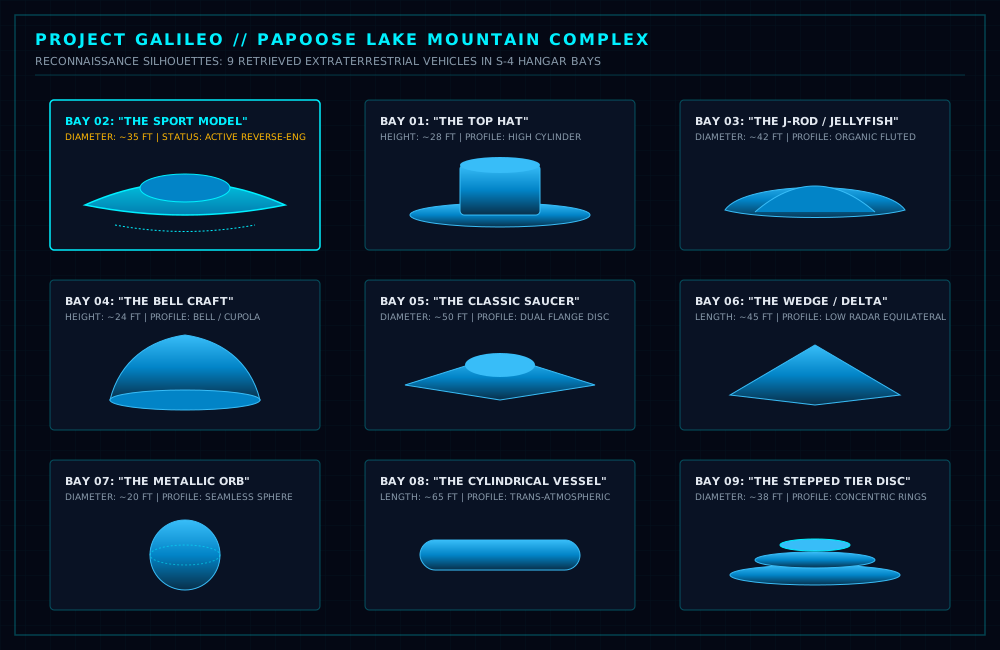
The craft differed radically in design and geometry: one resembled a flattened disc ("The Sport Model"), another resembled an elongated top hat, another had a bulbous bell structure, and another was shaped like a decaying jellyfish. Lazar was assigned to examine the propulsion core of the sleek, pewter-colored disc that he dubbed "The Sport Model".
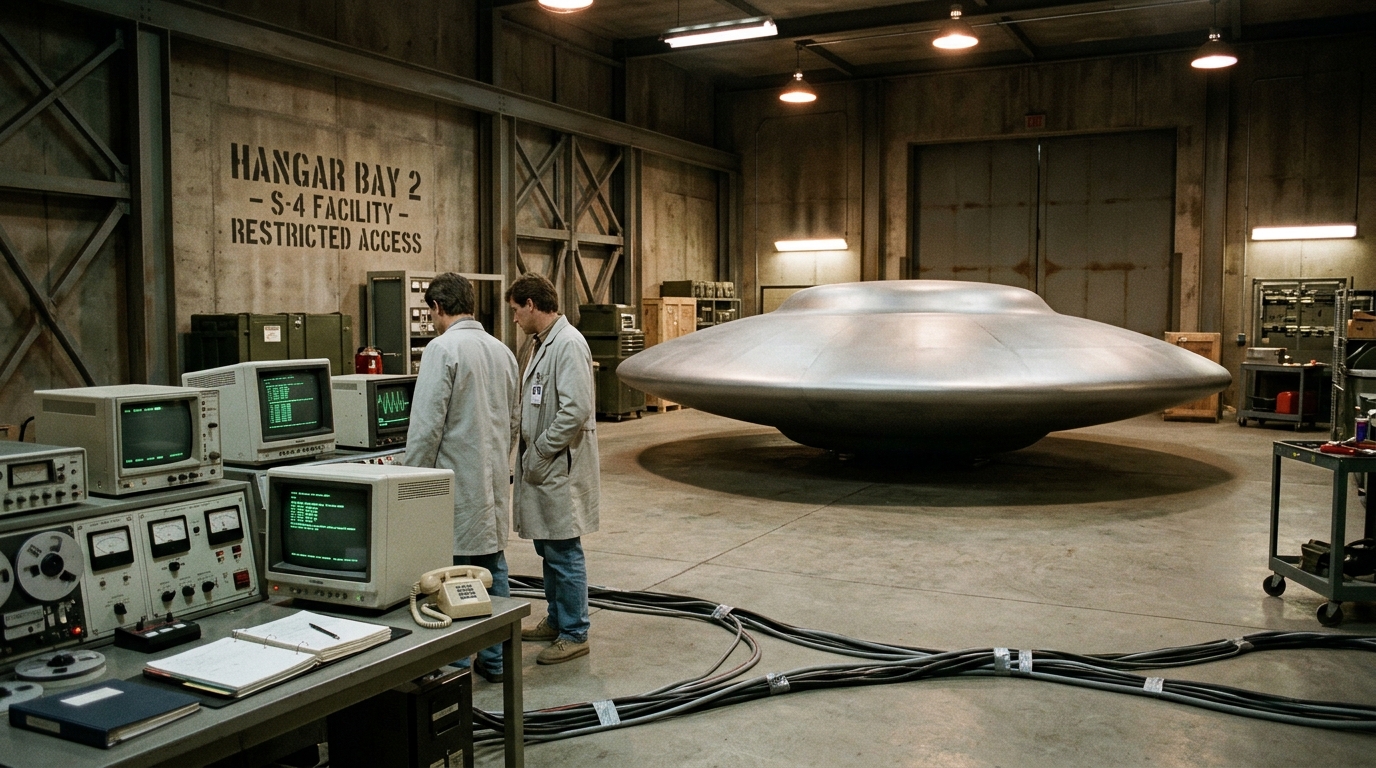
S-4 HANGAR BAY 2
Prior to hands-on analysis, Lazar was instructed to read through stacks of blue classified briefing folders. The documents outlined startling intelligence:
Lazar became aware of the scheduled flight test times occurring on Wednesday nights when commercial airspace was closed. Driven by disbelief and wanting proof, he brought close friends to public Bureau of Land Management (BLM) land at the edge of Groom Lake:
On multiple Wednesday nights in March and April 1989, Lazar, his wife Tracy, appraiser Gene Huff, and former pilot John Lear recorded glowing, pulsating discs performing maneuvers that defied inertia—stopping instantaneously, dropping thousands of feet in seconds, and hovering completely silently.
On April 5, 1989, their group was intercepted and detained by Lincoln County Sheriff deputies and Area 51 security teams. The following day, Lazar was subjected to intense debriefing at Indian Springs Air Force Base, stripped of his clearance, and threatened with assassination.
Convinced that the only way to safeguard his life was to make his story public so that his sudden disappearance or death would incriminate the authorities, Lazar approached KLAS-TV investigative reporter George Knapp.
In May 1989, he debuted anonymously under the pseudonym "Dennis" with his face cast in shadow and voice modulated. By November 1989, realizing that anonymity gave no protection, he stepped into the light under his real name. Overnight, Area 51 went from an unacknowledged classified desert testing patch to the most infamous epicenter of UFO lore on planet Earth.
Complete technical, geographic, and investigative repository for Sector Four (S-4) at Papoose Dry Lake. Featuring architectural blueprints, subterranean cutaway schematics, exact GPS coordinates with live Google Maps satellite preview, verified commute logistics, the fleet of nine extraterrestrial craft, and documented whistleblower video testimonies.
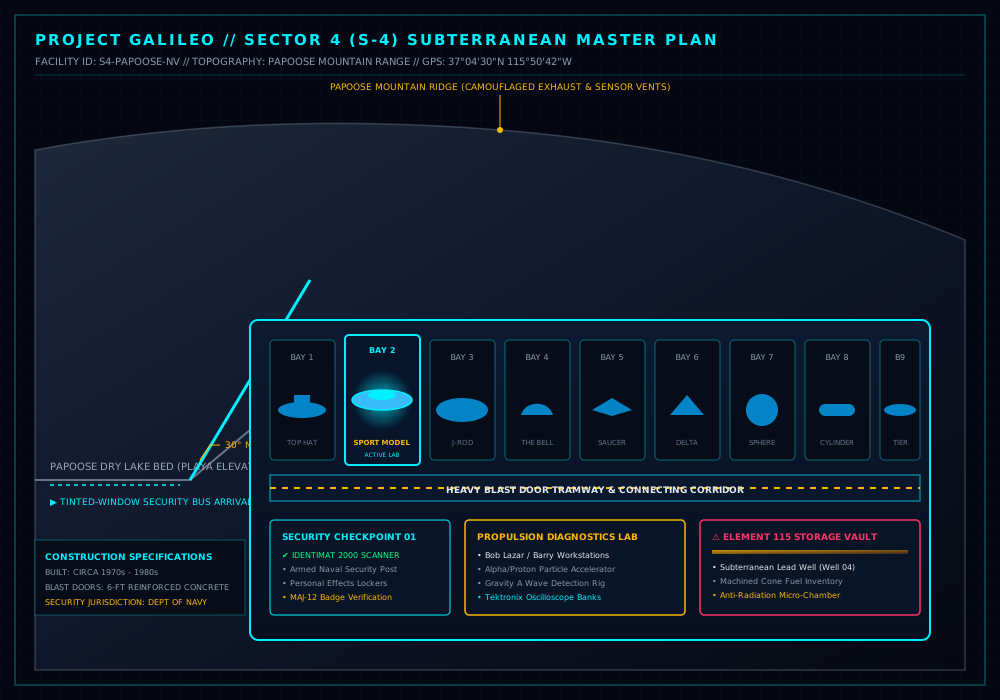
Complete subterranean layout showing the 9 contiguous hangar bays excavated into the mountain base, security checkpoint, and Element 115 storage vault.
CLICK FULL RES TO INSPECT IN NEW TABNine separate interlocking hydraulic hangar doors sloped at an exact 30-degree incline matching the natural mountain gradient. Textured with coarse desert-sand epoxy to completely eliminate shadow casting, visual discovery, and high-resolution satellite reconnaissance.
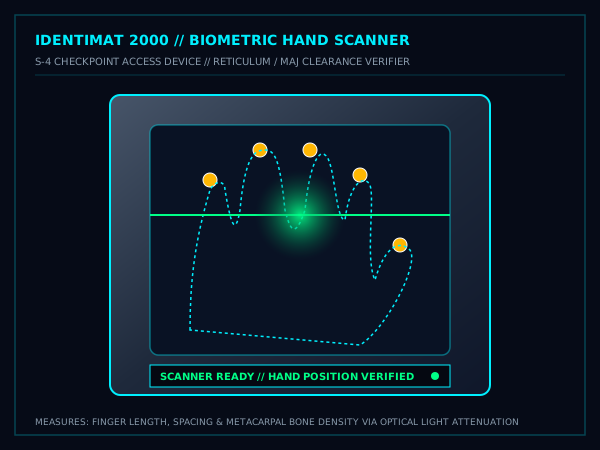
High-security checkpoint deployed at the subterranean entry. Employees placed their right hand over an optical plate with alignment pins where the Identimat 2000 measured hand geometry, finger length, knuckle spacing, and bone density before releasing blast doors.
Sub-basement lead-shielded containment vault (designated Well 04). Heavy lead cylindrical cannisters housed milled triangular cones of super-heavy Element 115 under armed Marine guard with dual-key inventory sign-outs and mass spectrometry logs.
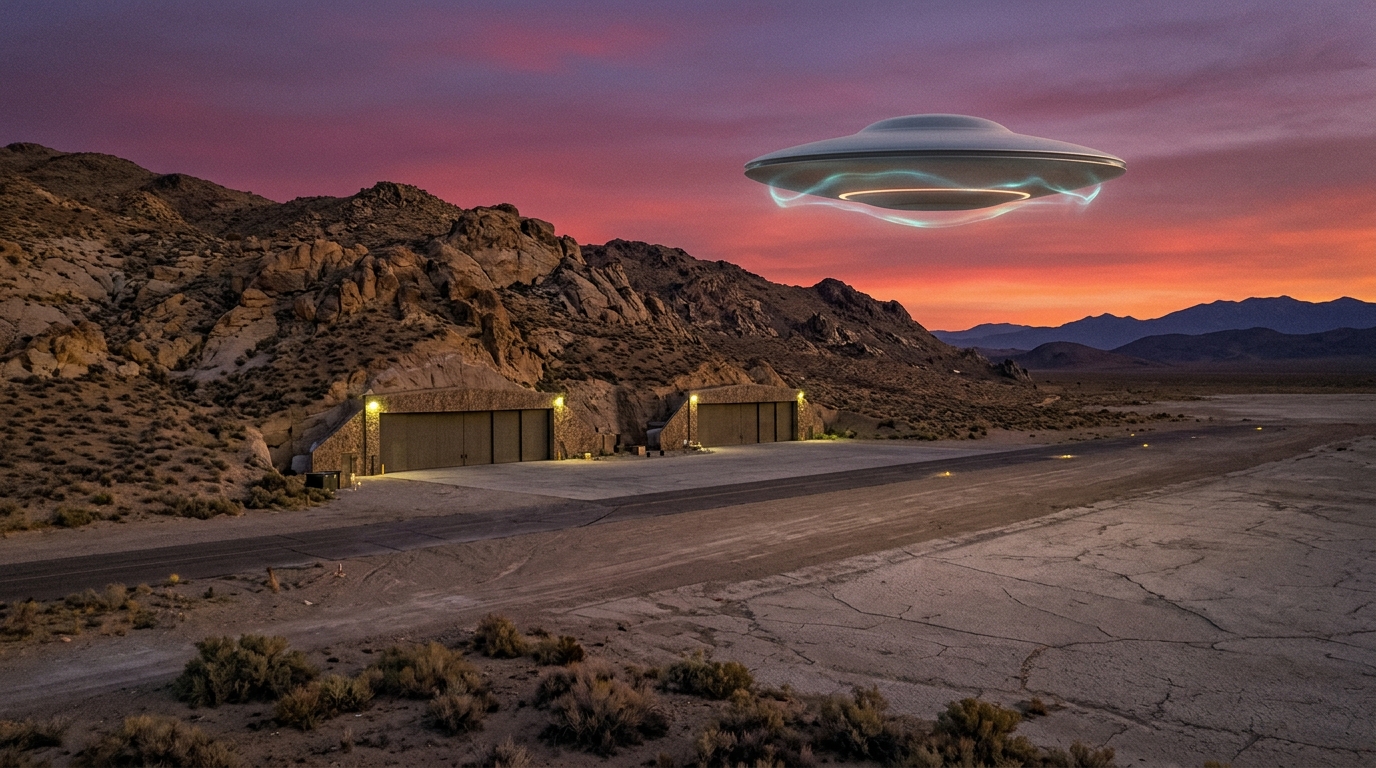
Excavated subterranean hangars on western slope of Papoose Mountain overlooking the dry lake playa. Restricted Airspace R-4808N. Protected by armed camouflaged patrols and thermal perimeter sensors.
Papoose Lake is a completely dry alkaline playa situated inside the Nellis Bombing Range, surrounded by jagged desert ridges that shield low-altitude flight tests from radar and optical sightlines. It is completely isolated from public view and sits within the most heavily restricted airspace on planet Earth.
When Bob Lazar walked through the interior corridor connecting the hangar bays, all nine inter-bay doors were opened, revealing that each of the 9 bays contained a radically different non-human vehicle. Lazar noted that none had logos, serial numbers, rivets, seam lines, or conventional flight controls.
The craft assigned to Lazar's team. Brushed pewter appearance, approximately 16 feet tall, 35 feet diameter. Powered by a basketball-sized Element 115 antimatter reactor and three independently gimballing gravity wave amplifiers on the lower deck.
Characterized by a broad horizontal lower flange and an elevated cylindrical upper section resembling an old-fashioned top hat. Lazar observed that the upper hull had faint iridescent coloration under fluorescent light.
A bulbous, heavy craft with a high-arching central canopy. This exact craft configuration was later independently described by flight simulator engineer Bill Uhouse and microbiologist Dan Burisch in their separate S-4 testimonies.
Flaring flared-skirt geometry rising to a domed apex with smooth metallic contours. Reminiscent of historical wartime accounts of non-aerodynamic vertical-lift vehicles with deep lower-hull mass centers.
The archetypal double-convex flying saucer with concentric equator rings and a shallow top dome. Lazar reported this vehicle appeared completely pristine, as though newly manufactured or preserved in a sterile environment.
Unlike the circular discs, this vehicle had faceted triangular geometry with angled leading edges, suggesting possible dual-mode aerodynamic travel or an evolutionarily distinct manufacturer.
Completely spherical orb vehicle resting in a concave cradle. No visible landing gear, seams, windows, or thrusters. Lazar noted engineers were puzzled by how personnel would enter or egress the orb.
Elongated cylindrical fuselage with rounded hemispherical caps at both ends, matching historical sightings of "flying cigars". Bay 8 was noticeably deeper into the mountain rock to house this vehicle.
Features three pronounced horizontal steps ascending toward the upper dome. Lazar reported that this craft appeared damaged or partially excavated, with visible internal honeycomb matrix structures.
Workers arrived at the secure private EG&G terminal on Haven Street at McCarran International Airport. Passports and security clearance badges were verified by armed security before boarding.
A 25-minute classified flight aboard an unmarked Boeing 737 featuring a single red cheatline (callsign "Janet"). The flight crossed Restricted Airspace R-4808N directly to the Groom Lake runway.
At Groom Lake, personnel boarded a civilian bus with heavily blacked-out windows. The bus drove south approximately 15 miles over unpaved dirt mountain roads directly to the Papoose Dry Lake basin.
The mountain hangar doors slid open hydraulically, allowing the bus to enter directly into the mountain. Workers cleared the Identimat 2000 bone scanner before passing through heavy blast doors into their labs.
Bob Lazar describes the exact layout of S-4, the hangar doors, the 9 discs, Element 115, and the FBI raid with Joe Rogan.
Lazar knew the exact testing schedule: Wednesday nights around dusk when commercial airline traffic subsided and Soviet reconnaissance satellites were over the horizon. On March 22 and 29, 1989, he took Gene Huff, John Lear, and investigative journalist George Knapp to Highway 375. All of them witnessed and videotaped glowing orange-gold spheres performing sharp, impossible manoeuvres directly above the Papoose Mountain ridge.
Former Marine Corps pilot and mechanical engineer Bill Uhouse testified on the record for Steven Greer's Disclosure Project that he spent years at S-4 building high-fidelity human flight simulators for the reverse-engineered discs. Uhouse described the identical 30-degree mountain hangar doors, the Identimat security check, and working on cockpit control interfaces designed for three extraterrestrial crew members.
Dr. Dan Burisch (Danny Crain) claimed to have served as a contract microbiologist for Majestic 12 inside S-4. In long-form video interviews with researcher Bill Hamilton, Burisch detailed the exact layout of the subterranean complex, the blue badge security protocols, and taking cellular samples inside a biosafety level 4 "Clean Sphere" housing an extraterrestrial biological entity codenamed J-Rod.
Teenage rocketry prodigy David Adair testified that in 1971, General Curtis LeMay flew him into Groom Lake to inspect an underground hangar housing a giant fusion-containment engine. Adair described the engine as "organic and living"—exhibiting no seams, responding to mental electromagnetic frequencies, and matching the biological seamless alloy that Lazar described 18 years later at S-4.
Prominent researchers like Dr. Jacques Vallée and computer scientist Dr. Eric Davis have posited that Lazar may have been deliberately fed disinformation or shown elaborate mockups at S-4 to test counter-intelligence containment, conceal advanced Soviet stealth drone testing, or monitor the dissemination of black-budget aerospace leaks.
Aerospace engineers and geological whistleblowers suggest that the 9 hangars at S-4 are merely the surface access portals of an extensive multi-level subterranean facility extending hundreds of feet beneath the Papoose Lake basin, connecting to Groom Lake, Mercury, and the Nevada Test Site via high-speed subterranean mag-lev transit tubes.
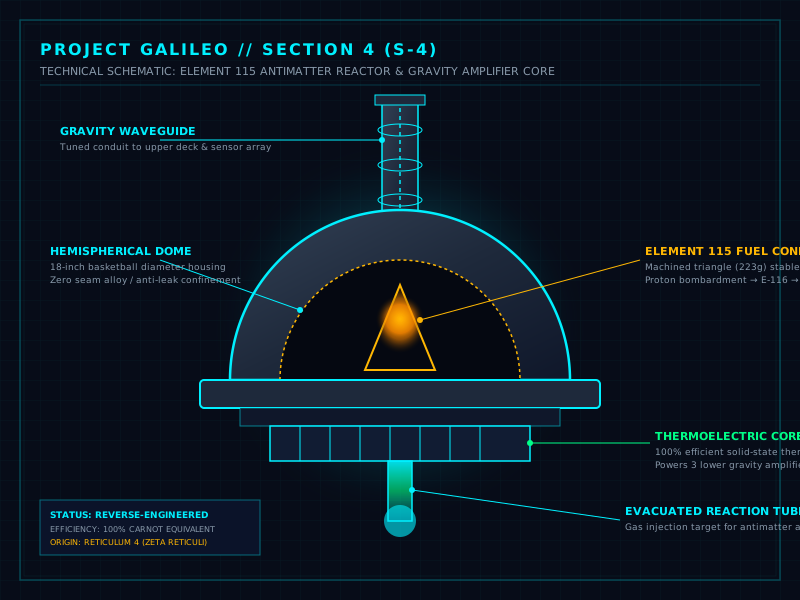
Interactive real-time cross-section schematic and spacetime warping simulation based on Bob Lazar's original technical blueprints and S-4 engineering notes.
How an antimatter reactor, the strong nuclear force (Gravity A), and metric engineering enable faster-than-light travel without violating Einstein's General Theory of Relativity.
In May 1989, when Bob Lazar first publicized his account, the periodic table concluded at element 109 (Meitnerium). Lazar explicitly stated that the S-4 craft utilized an orange-tinted, machined cone of Element 115 as its primary fuel.
Fourteen years later, in 2003, a joint team at the Joint Institute for Nuclear Research in Dubna, Russia and Lawrence Livermore National Laboratory synthesized the element for the first time. In 2016, the International Union of Pure and Applied Chemistry (IUPAC) officially recognized it as Moscovium (Mc).
While current laboratory-synthesized isotopes of Element 115 decay in fractions of a second due to neutron deficiency, theoretical nuclear physics confirms the existence of an "Island of Stability" around spherical magic numbers (Z=114–126, N=184). Lazar maintains the extraterrestrial samples utilized a stable, neutron-rich isotope unavailable on Earth.
Mainstream physics treats gravity as a single macroscopic force described by spacetime curvature. Lazar explained that S-4 researchers identified two distinct manifestations:
Because Element 115 possesses such enormous nuclear mass, its Gravity A wave leaks beyond the perimeter of the nucleus. The reactor amplifies this wave, channels it through a central waveguide, and outputs it via the three lower directional amplifiers to manipulate the fabric of space.
A low-energy particle accelerator bombards the machined cone of Element 115 with protons.
Element 115 absorbs the proton, briefly transmuting into Element 116 (Livermorium).
Element 116 immediately decays, emitting antiprotons into an evacuated target chamber filled with gas.
Matter-antimatter annihilation converts 100% of mass into energy, powering the solid-state thermoelectric generator.
From the 1982 jet car to the S-4 briefings, the 1989 media revelations, the synthesis of Element 115, and the modern renaissance.
Born in Coral Gables, Florida on January 26, 1959. Demonstrates early, obsessive fascination with rocketry, solid rocket propellants, particle physics, and high-voltage circuitry.
Lazar installs a jet engine into a Honda hatchback, cruising at 200 MPH. Front-page feature in the Los Alamos Monitor refers to him as a physicist at LAMPF. Dr. Edward Teller reads the article and meets Bob Lazar before a scientific lecture.
Recruited by EG&G on Dr. Teller's recommendation, Lazar receives MAJESTIC clearance and begins reporting to S-4 at Papoose Lake. He is tasked with reverse-engineering the propulsion of "The Sport Model" craft.
Lazar takes friends Gene Huff, John Lear, and his wife to public BLM land bordering Groom Lake to witness scheduled Wednesday night test flights. On April 5, 1989, they are detained by Lincoln County Sheriffs and Area 51 security. Lazar's security clearance is terminated under death threats.
Lazar steps forward with investigative reporter George Knapp. First broadcast under pseudonym "Dennis" in May, followed by full public appearance under his real name in November. "Area 51" is launched into global public awareness.
Lazar produces an exhaustive video documentary outlining the technical schematics of the Sport Model, gravity A and B wave propulsion, and Element 115 physics to create an unalterable historical record.
Nuclear physicists in Dubna, Russia synthesize Element 115—14 years after Lazar named it on television. In 2016, IUPAC officially adds Element 115 to the periodic table as Moscovium (Mc).
Jeremy Kenyon Lockyer Corbell releases the award-winning feature documentary Bob Lazar: Area 51 & Flying Saucers (narrated by Mickey Rourke). Simultaneously, the FBI stages a dramatic raid on Lazar's United Nuclear facility in Michigan.
Lazar appears on The Joe Rogan Experience (#1315), watched by over 50 million viewers. He publishes his memoir Dreamland: An Autobiography and continues operating United Nuclear in Michigan.
An objective, investigative appraisal of the documentation, physical devices, predictions, and unresolved academic controversies surrounding Bob Lazar.
After officials denied Lazar worked at Los Alamos, George Knapp located an internal 1982 LANL directory listing "Lazar, Robert" (ext 2801) as staff under contractor Kirk-Mayer, complete with DOE security clearance symbols.
Lazar's 1989 description of the biometric hand scanner at S-4 was dismissed as sci-fi fabrication. Decades later, declassified photos confirmed the US military deployed the exact "Identimat 2000" at top-secret nuclear facilities.
Lazar preserved an authentic 1989 W-2 form listing his employer as the "Department of the Navy" with an OMB code corresponding to classified naval intelligence operations.
Predicted the existence and practical utility of Element 115 a full 14 years before particle accelerators in Russia successfully synthesized it in 2003.
Lazar stated he earned degrees from MIT and Caltech. However, neither university possesses registrar records, graduation logs, or faculty recollections of his enrollment. Lazar asserts the US government wiped his academic records to destroy his credibility; critics argue he never attended and attended Pierce College instead.
Laboratory-synthesized isotopes of Moscovium decay in milliseconds (approx. 200 milliseconds). Mainstream nuclear physicists argue that even if an Island of Stability exists at N=184, creating an isotope stable enough to machine into solid fuel cones remains unproven by terrestrial experiments.
Commercial satellite imagery of Papoose Lake does not show overt runways or surface structures. Lazar's explanation that hangars were built directly into the mountain base with desert-matching camouflaged 30-degree doors explains this, but definitive satellite confirmation remains classified.
Critics often assume whistleblowers profit from book tours or television deals. In reality, Lazar lived modestly, declined high-dollar media fees, and spent 30 years running a chemical supply company, consistently expressing regret that coming forward damaged his scientific career.
Far from the spotlight of UFO conventions, Bob Lazar lives a quiet life in rural Michigan running an independent scientific supply company and engineering clean hydrogen transport.
Lazar founded United Nuclear Scientific Equipment & Supplies, headquartered in Laingsburg, Michigan. United Nuclear is a primary source for high-purity elements, rare chemicals, Geiger counters, cloud chambers, radioactive check sources, and aerospace-grade neodymium magnets.
Committed to clean energy, Lazar modified his Chevrolet Corvette to run purely on hydrogen gas using metal hydride storage tanks. He engineered a solar-powered electrolysis generator at his home to split water into pure hydrogen fuel, driving for years with zero carbon emissions.
In 2018, dozens of federal agents raided United Nuclear's Michigan premises. While official warrants cited tracing a customer transaction, the raid occurred the exact day after Lazar and filmmaker Jeremy Corbell privately discussed possessing a sample of Element 115, raising intense speculation.
Lazar does not give paid speeches at UFO conventions or seek public adulation. His daily life revolves around practical chemistry, teaching young people to love science through United Nuclear kits, and experimenting in his laboratory. As he told Joe Rogan: "I just want to do science, make things in my shop, and be left alone."
Bob Lazar does not accept donations or solicit hand-outs. The best and most authentic way to support him is through his independent scientific business, official books, and documented media projects.
Order directly from Bob's company. United Nuclear sells high-grade neodymium magnets, pure element samples, laboratory glassware, radiation detection instruments (Geiger counters), cloud chambers, and chemistry kits.
Purchase official, large-format commemorative prints of the S-4 "Sport Model" and its reactor core hand-drafted and authorized by Bob Lazar. Available directly through United Nuclear and official archival releases.
Read Bob Lazar's complete, unvarnished story in his own words. Published in 2019, Dreamland covers his early rocket experiments, the day-to-day work at S-4, and the personal fallout of blowing the whistle.
Directed by investigative filmmaker Jeremy Kenyon Lockyer Corbell and narrated by Mickey Rourke. Features contemporary interviews, the 2018 FBI raid footage, and audio tapes from the S-4 debriefings.
Over 2 hours of unfiltered, technical discussion covering every question about S-4, the propulsion physics, migraines, Element 115, and the FBI raid with Joe Rogan and Jeremy Corbell.
Purchase United Nuclear science kits, isotope demonstration sets, or cloud chambers and donate them to your local high school physics and chemistry laboratory to kindle the love of experimental science in future generations.
Direct answers to the most common questions, misconceptions, and controversies surrounding Bob Lazar's life and claims.
Lazar specifically worked at Sector 4 (S-4), located approximately 15 miles south of the primary Groom Lake flight test center (Area 51) at the base of the Papoose mountain range. While his Janet flights landed at Area 51, workers were transported by bus with blacked-out windows to the concealed S-4 hangars. Main Area 51 tests advanced human military black projects (like the U-2, SR-71, and F-117), whereas S-4 was dedicated exclusively to extraterrestrial reverse-engineering.
Lazar and his close confidants (including Gene Huff) have stated that a small quantity of Element 115 was removed from the facility prior to his departure to verify its gravitational bending properties in an independent cloud chamber experiment. While footage exists showing a cloud chamber test bending light, Lazar has never publicly produced the sample, citing the extreme danger of federal prosecution or assassination.
This remains the most heavily contested aspect of Lazar's story. Lazar claimed to have earned master's degrees from MIT and Caltech. When reporters checked, both institutions stated they had no record of him. Lazar maintains that as part of an official program to sanitize his identity and discredit his testimony, his academic transcripts were expunged—similar to how government officials initially falsely claimed he had never worked at Los Alamos, until George Knapp uncovered the 1982 LANL telephone directory proving he was indeed on staff.
Yes. In 2003, Russian and American physicists successfully synthesized Element 115 at the Dubna Joint Institute for Nuclear Research, and in 2016 IUPAC named it Moscovium (Mc). While current terrestrial lab isotopes decay in fractions of a second, nuclear physicists acknowledge the theoretical existence of an "Island of Stability" around 184 neutrons where superheavy elements can achieve long half-lives.
In 2018, dozens of FBI agents raided United Nuclear's Michigan headquarters. The official search warrant claimed investigators were looking for records related to a chemical shipment purchased by a customer years earlier. However, the timing coincided eerily with private conversations between Lazar and filmmaker Jeremy Corbell about the physical whereabouts of Element 115. Agents reportedly searched specifically for small, heavy lead containers.
No. Unlike typical public speakers, Lazar has routinely refused paid appearances, lecture tours, and convention sponsorships. He spent the last 30 years supporting himself through United Nuclear, supplying chemicals and equipment. He has repeatedly stated that speaking out damaged his professional career, brought continuous government surveillance, and resulted in intense personal stress.
Peabody Award-winning investigative journalist George Knapp conducted months of meticulous vetting. Knapp corroborated that Lazar knew flight test schedules in advance, had an active Los Alamos directory entry, possessed authentic naval intelligence W-2 paperwork, and described classified security devices (the Identimat scanner) that only someone with inside clearance could have witnessed.